Tuesday, June 18, 2013

ROSE

 
ROSE-Rosa Damascena, Rosa Gallica, Rosa Rugosa, Rosa Centifolia

Also known as Damask rose, Dogrose, Wild rose, Living fence, Rambling rose, Japanese rose, etc. etc. etc.

Parts used:  flowers, hips and in some cases, the leaves and root bark

Meridians/Organs affected:  liver, spleen, kidneys, bladder, colon

Properties:  carminative, stimulant, emmenogogue, antimicrobial, astringent, diuretic, tonic, antibiotic, antidepressant, antispasmodic, antiseptic, aphrodisiac, sedative, antiscorbutic

Roses have been around since time started, literally.  They are mentioned since man started keeping records, and there are fossils of roses dating back 32 million years.  You can find them referred to by poets of various cultures including Persian, Greek and Chinese.  Dried roses were found buried with King Tut-purportedly put there as a sign of love by his beloved.

Throughout the ages, it has been grown as an ornamental plant valued for its beauty and aroma.  There are very few 'pure' roses.  Most roses today (there are over 16,000 varieties of rose at current) are hybrids, crosses, etc.  One of the most revered roses, the Damask rose, is the principal ancestor to many of the rose varieties.  The Damask rose is said to have appeared in France around the time of the Crusades.  It is the source of the best attar (oil).  The Damask rose only gets about 3 feet in height and ranges in color from pale pink to pure white to a deep red. 

Another great rose of ancient origin is the Provence Rose (also known as Rosa Gallica).  It has deep red blossoms and grows 2-3 feet in height.  Both these varieties of rose (the damask and the provence) bloom but once a year.
One other rose of importance is the Rugosa rose.  This is more of a shrub and it has little tiny fruits (hips) on it in the fall after the flowers have gone.  It can get anywhere from 5-15 feet in height and grows in heated soil, cold, sandy soil, clay soil and in dry or humid climates.  It is a native of China, Korea and Japan and was introduced to this country by the early explorers.  This is the wild rose variety we have all over the United States.
The flowers and leaves shoud be gathered between May and July and the rose hips should be harvested between September and November from 8 a.m. to 5 p.m. at their most medicinal. 

Throughout time, roses have been the subject of poetry, art, literature, medicine and love.  The Romans and Greeks would adorn their banquet halls with them as it was believed that anything said would be held in the strictest confidence during that time or otherwise (such as war councils, etc).  This is where the term 'sub-rosa' came into being and is still employed by lawyers today.  They would also adorn their young brides with roses as a symbol of love and purity and they would lay wreaths and garlands of roses at Cupid's and Venus' feet in hopes of being blessed with true love.  (Ah, if it were only that easy).  There are stories saying that roses never had thorns until after the Fall of Adam while other stories state that a rose bush was struck by Cupid's arrow making it grow thorns from that point on.  Whatever the reason, the thornless varieties DO NOT contain near the vitamin C of the wild roses.  (It is believed that one rose hip from a wild rose contains between 350-500 mg of vitamin C.  ONE ROSE HIP!)

Each color of rose is supposed to represent something different as well.  Red was for passion and desire, yellow for jealousy or to signify an achievement, pink represented simplicity, happiness and love and white was for purity and innocence.

The dogrose was named such as it was believed in medieval times to cure rabid animal bites.  The Shah Jahan had rose petals put in the canals to celebrate his wedding (his bride was the one that the Taj Mahal was built for).  When the Shah's intended noticed the oil particles floating on the water, she had them collected and used it for a perfume-and thus the perfume industry has used it ever since.

Roses have been used as a culinary, aromatic and medicinal agent for centuries.  The flowers are edible and can be used in salads, syrups, jams, jellies, etc.  They are often crystallized as well for confections.  The flowers are also where the essential oil comes from.  It takes about 2-5 tons o roses to make 1 pound of rose otto or attar of rose essential oil.  You can appreciate the price (highly expensive for real rose oil) knowing how much work is involved.  If you are using rose oil for therapeutic or medicinal/culinary uses, those are the only two oils you want (the rose otto or the attar of rose from damask, provence or rugosa roses).  Any other rose preparation is made with solvents instead of steam distillation and you don't need those chemicals in your body.  Those preparations are best used for aromatic purposes only.

Rose oil has been used to assist in the birthing process by many a midwife.  They have also been used for sore throats, to heal wounds, for coughs, mouth sores, gingivitis, herpes outbreaks, inflammation, congestion, digestive issues, headaches, nausea, vomiting, constipation, menstrual issues, to balance female hormones, for frigidity, impotence, infections, depression, muscle spasms, to calm the nerves and lift the spirits, to reduce stress and tension, to ease tension, for insomnia and to stabilize mood swings.  It has been used ad infinitum for all kinds of skin issues to great effect including wrinkles, mature, dry skin, sensitive skin and for broken capillaries.

The root bark tea has been used for diarrhea, upset stomach and to reduce labor pains during childbirth.  This tea was also used as an eyewash for snow-blindness.

A decoction of the root has been used in hot compresses to reduce swelling and as a gargle for tonsillitis, bleeding of the mouth and sore throat.

Rose petals have been used as an infusion for colic, headaches, heartburn and a host of other maladies. 

The American indians would cook the seeds and ingest them to help with muscle pain.  A poultice of the leaves was used for insect stings and bites.

The Chinese would use the tea to treat intestinal disorders and for worms.

Roses are not just a good source of vitamin C but also a source for vitamins A, B3, D, E, P, K and zinc, as well as a host of other valuable nutritive items.

Wild rose is also one of the Bach flower essences.  This is the essence you give to someone who is apathetic, lacks drive or ambition, who is resigned to their illness or lot in life and has no will power.

Rose is an herb that improves the appetite, thus is good for those suffering from anorexia or an eating disorder.  It helps to harmonize the blood and assist in regular menses.  It also helps to dry up colds and clear up mucus discharges.  Rose hips can help with bed wetting, frequent urination, leucorrhea and spermatorrhea (which are all signs of deficient kidney function).

This powerhouse of nutrition and medicine seems to have been pushed aside over the years for newer things.  It not only deserves a place in your garden but in your kitchen and in your medicine cabinet.  You might be grateful you have it one day.

A word of caution-the inner seeds are not easily palatable as they have small hairs on them.  All members of the rose family have cyanide like compounds in the seeds that can only be destroyed by cooking or drying.  So please be aware of that fact when using them. 

As is customary with my posts I have included some links below that you might find useful and interesting.  Stay strong and healthy!

http://www.amazon.com/Oregons-Wild-Harvest-Rose-ORGANIC/dp/B007P6J2GA/ref=sr_1_2?ie=UTF8&qid=1371603210&sr=8-2&keywords=wild+rose+herb

http://www.amazon.com/Night-Cream-Young-Vitamins-before/dp/B004X1EOTA/ref=sr_1_3?ie=UTF8&qid=1371603210&sr=8-3&keywords=wild+rose+herb

http://www.amazon.com/Damask-Rose-Ramnose-Biosacaride-Cream-6-76/dp/B000J10JHY/ref=sr_1_2?ie=UTF8&qid=1371603424&sr=8-2&keywords=damask+rose+otto+oil

http://www.amazon.com/Bulgarian-Rose-Otto-20ml-Deryuto/dp/B001MT3PC8/ref=sr_1_7?ie=UTF8&qid=1371603546&sr=8-7&keywords=damask+rose+otto+oil

http://www.amazon.com/Rose-Essential-Bulgaria--Damascena--8oz/dp/B007C08O72/ref=sr_1_fkmr0_1?ie=UTF8&qid=1371603624&sr=8-1-fkmr0&keywords=damask+rose+otto+oil

http://www.amazon.com/Pre-Provence-Petal--Ounce-Cello/dp/B001LNOEQQ/ref=sr_1_fkmr1_1?s=beauty&ie=UTF8&qid=1371603728&sr=1-1-fkmr1&keywords=provence+attar+of+rose+oil

http://www.amazon.com/La-Compagnie-Provence-Liquid-Marseilles/dp/B001XTXIBK/ref=sr_1_fkmr1_3?s=beauty&ie=UTF8&qid=1371603728&sr=1-3-fkmr1&keywords=provence+attar+of+rose+oil

http://www.amazon.com/La-Compagnie-Provence-Liquid-Marseilles/dp/B001XTXIBK/ref=sr_1_fkmr1_3?s=beauty&ie=UTF8&qid=1371603728&sr=1-3-fkmr1&keywords=provence+attar+of+rose+oil

http://www.amazon.com/ELMA-SANA%C2%AE-Organics-Moroccan-Water-/dp/B003XKW8RM/ref=sr_1_1?s=beauty&ie=UTF8&qid=1371603928&sr=1-1&keywords=rose+water+organic

http://www.amazon.com/Organic-Rose-Water-Bulgarian-organic/dp/B001KPSO5M/ref=sr_1_3?s=beauty&ie=UTF8&qid=1371604082&sr=1-3&keywords=rose+water+organic

http://www.amazon.com/Garden-Life-Wild-Herbal-D-Tox/dp/B00CLD7214/ref=sr_1_5?ie=UTF8&qid=1371604408&sr=8-5&keywords=wild+roses

QUEEN ANNE'S LACE


QUEEN ANNE'S LACE-Daucus Carota

Also known as wild carrot, bird's nest root and bee's nest plant.

Parts used:  whole plant

Meridians/Organs affected:  kidneys, female reproductive, intestines, bladder, stomach

Properties:  stimulant, diuretic, stomachic, deobstruent, anthelmintic, antimicrobial, hypotensive

Queen Anne's Lace is a tall, slender plant with fern-like leaves an lace-like white flowers that form a flat topped umbel.  They flower from June to September and are self pollinating although they can be insect pollinated as well.  About one in every four plants has a single deep purple flower in the center of the flower cluster referred to as the 'fairy's roost' (don't ask me why as I do not know).  When Queen Anne's Lace goes to seed, the flowers kind of close up into what would resemble a concave bird's nest (no doubt where it got one of it's other names).  The seeds are covered with small barbs that make it more easily dispersed by the animals.  A single plant can produce 4,000 seeds which is why it is easy to see how it can self-propagate with ease.  It can be found in grasslands, meadows, dumps, rock outcroppings, vacant lots, stone walls, railroad tracks that are out of the way and roadsides.  It grows about 2-4 feet in height while its poisonous look alike (hemlock-pictured below) gets much taller (often from 5-8 feet high).  Queen Anne's Lace is also covered in very fine hairs where hemlock is not. 

(hemlock)
 
Originating in North Africa and Eurasia, this plant now can be found in most temperate climates throughout the world.  The seeds of this herb have been used for many years as a "morning-after" contraceptive in European countries.  It has also been used in India to reduce female fertility.  Even Dioscorides wrote of its anti-fertility properties.  The leaf tea also has been used for bladder and kidney stone and often will work when other things do not.  (However, as this plant is a uterus stimulant, please do not take when pregnant and have kidney or bladder stones at the same time...there are better options for pregnant women).  In the same respect, it is used to kill worms and expel them from the system.
 
There is some debate over Queen Anne's Lace as to whether or not it is related to the domestic garden carrot.  According to Dr. Christopher, the only similarities they share are the leaf and the carrot like scent (which can be gotten by scraping one's nail on the stem/stalk of the plant).  Other sources say that Queen Anne's Lace is the ancient species and the ancestral parent to the current domestic variety.  Yet others say that they are related distantly and can be used interchangeably.  So...my advice would be to use your own judgment.  Get to know the plant well before deciding to use it, often the plants will tell you plenty if you take the time to observe them.
 
 
This plant is a biennial.  The first year the fern-like leaves appear, the second year the stalk with the umbel flower clusters form.  Both the leaves and the seeds can be dried and used as seasoning or made into tea.  (Again, not for use when pregnant).  The leaves are best gathered the first year they appear while the seeds are best gathered in the autumn of the second year.  Both the leaves and the seeds are great carminatives helping with stomach issues and flatulence.  The seeds have also been used to decongest the liver and were even considered to be a drug at one point by the U.S. Pharmacopeia (from 1820-1882).  Extracts of the whole plant have been used for cystitis and urinary stones.  The seeds have been shown to help with menstrual isses and to stimulate the uterus.
 
The root tea has been found to be diuretic in nature and beneficial for gout.  The leaves contain components that interact with the pituitary (the master gland in the body), thus increasing the production of sex hormones.  Wild carrot is a natural antacid (as are domestic carrots) and as such is an interesting alternative for heartburn and gastritis.
 
Whatever you choose to do with this plant...be sure it is Queen Anne's Lace and not Hemlock as hemlock will kill you in a matter of days. 
 

As is customary with my posts I am including some links regarding Queen Anne's Lace that you might find interesting.  Use them as you see fit.

http://www.amazon.com/Queen-Annes-majus-Wildflower-Seeds/dp/B003ADIUCE/ref=sr_1_cc_3?s=aps&ie=UTF8&qid=1371600021&sr=1-3-catcorr&keywords=queen+anne%27s+lace

http://www.amazon.com/Flower-Essence-Quintessentials-Organic-Supplement/dp/B0025P0OLS/ref=sr_1_1?s=hpc&ie=UTF8&qid=1371600227&sr=1-1&keywords=queen+anne%27s+lace

http://www.amazon.com/Parsleys-Fennels-Queen-Annes-Lace/dp/0881928224/ref=sr_1_1?ie=UTF8&qid=1371600332&sr=8-1&keywords=queen+anne%27s+lace+herb

CHAMOMILE


CHAMOMILE-Anthemis nobilis (Roman), Matricaria chamomilla (German), Anthemis tinctoria (ox-eye chamomile), Anthemis catula (dog fennel), Matricaria inodora (mayweed)
 
Also known as Roman chamomile, German chamomile, whig plant, manzanilla and garden chamomile.
 
Parts used:  flowers
 
Meridians/Organs affected:  lungs, live and stomach
 
Properties:  stimulant, tonic, aromatic, bitter, anodyne, emmenogogue, stomachic, antispasmodic, calmative, nervine, diaphoretic, carminative, antiseptic, antibacterial, anti-inflammatory, antifungal
 
Chamomile is a member of the sunflower/daisy family.  There are many varieties of this plant but the most well known are the Roman and German types.
 
Native to EurAsia, chamomile is now found throughout Europe, Asia, Egypt, North America and parts of Russia.  It has been cultivated all over the world for its medicinal uses.  The domestically raised chamomile often will not get biggerthan eight to nine inches in height while the wild variety can get as large as three feet high.  It is best collected (and at its most medicinal) between July and August from 10 a.m. to 5 p.m.
 
The ancient Egyptians considered chamomile a sacred plant and would often leave it as a gift to the sun god, Ra, to honor and appease him.  They would also use the oil to massage into their skin to cool fevers and help alleviate any aches and pains, especially those relating to muscle spasms and soreness.  (The Egyptians were WAY ahead of their time in regards to natural medicine).  The Greeks call this plant 'kamai melon' which translated means 'ground apple' .  This is due to the apple-like scent the flower emits.  They (the Greeks) would often use chamomile in poultices and baths to help dissipate issues involving the liver, kidneys and bladder.  It was also usedin this manner for headache relief.  The Spanish refer to chamomile as 'manzanilla' which means 'little apple' . 


The Europeans in the middle ages would put chamomile on their floors so as to make their homes more fragrant, those coming and going would trample the flowers, releasing their sweet scent into the home.  Beatrix Potter even spoke of chamomile in her books on Peter Rabbit, stating that Peter's mother would often give it to him to calm him.  Chamomile tea has often been used for just such a purpose-to calm the system and induce a restful sleep.  It has also been said to reduce or prevent nightmares.  (Something to consider for using for PTSD I should think....)
 
Chamomile has been used for hundreds of years by herbalists for various maladies including colic, heartburn, loss of appetite, diarrhea, gout, headaches, indigestion and as a diuretic.  It has been used in poultices for pain, swelling and abscesses.  It has been used by many a gardener for its ability to repel insects.  It has often also been referred to as the "plant's physician" as it seems to cure any sick plant it is planted next to.
 
Chamomile has many members in its species.  There is often some debate over which chamomile is the most medicinal.  The English prefer Roman chamomile which is often referred to as just 'chamomile'.  The Germans would say that the German chamomile is more medicinal due to the azulene content (which turns the oil blue and is not actually IN chamomile but appears through the steam distillation of the german chamomile variety).  Azulene does add medicinal components (it is a natural anti-inflammatory), and many people prefer to use German chamomile for all types of skin infections and diseases including eczema and psoriasis.  t is also the oil thatis most often used in creams and salves for sore muscles and joints, sprains, strains, bruises, inflamed tendons, arthritis and rheumatism.
 
Interestingly enough, modern European allopathic doctors often prescribe chamomile for the same ailments their herbalist predecessors did.  (Tis a shame more allopathic physicians in this country do not integrate their practices).  In Germany, they use chamomile oil for female disorders, depression, stress, irritability and chronic fatigue.  As chamomile is well known for its mildness, it is often used for children and infants as well.  Mothers of many children have used it to calm hysterical kids, soothe colic and stomachaches, relieve toothaches and teething pain, and ease earache pain and reduce fevers.  It is also purported to help calm hyperactivity.
 
Modern man has added it to hair care products, lotions, perfumes, etc.  Chamomile seems to not only add shine and silkiness to the hair but also conditions the scalp.  In WWII it was not uncommon to be used in hospitals and doctor's offices as an antiseptic and disinfectant.  In fact, the antiseptic power of chamomile is said to be 120 times greater than sea water or salt water.  The tea has also been used to expel worms in children, for colds, flu, hemorrhoids, asthma, allergies and hay fever.  It is also often combined with ginger for acid indigestion and gas.
 
Chamomile tea is the most popular tea in the world.  It is also popular as a flavoring agent and is used to flavor vermouth, bitters, desserts, candies and a variety of non-alcoholic beverages.  Chamomile has also been studied for a great many years.  The volatile oils it contains have been found effective against staph, candida and a host of other fungi and bacteria.  These oils are effective for and act upon the liver, spleen, kidneys, stomach, uterus and bladder.  The tea also makes an excellent eyewash and has been used to clean open sores and wounds as well as aid in the treatment of gangrene.
 
DO NOT USE THIS HERB IF YOU ARE ALLERGIC TO RAGWEED!  Chamomile is in the same family as ragweed and may cause and adverse reaction.  To test for sensitivity, brew some chamomile tea and take a small sip.  If a reaction occurs within 20 minutes (rash or swelling), do not take chamomile in ANY form. 
 
As with any of my postings I have included several links below to items concerning chamomile.  Please use them as you see fit. 


Thursday, May 23, 2013

SHEPHERD'S PURSE

Shepherd's Purse: Capsella Bursa-Pastoris

Also known as Mother's Heart, blind weed, St. James weed, lady's purse, shepherd's bag, witches pouches, St. Anthony's fire, case weed, shepherd's sprouts, rattle pouches, pepper grass, etc.

Parts used:  entire plant

Meridians/Organs affected:  blood, liver, stomach and uterus

Properties:  hemostatic, mild astringent, mild stimulant, anti-hemorrhagic, detergent, vulnerary, urinary antiseptic, antipyretic

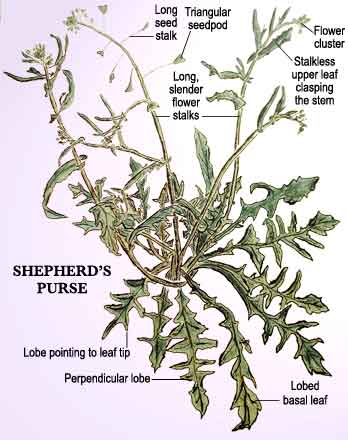
Shepherd's Purse is in the mustard family and orginated in Europe.  It can be found readily all over the globe now-usually along roadsides, moist areas, sidewalks, gardens, lawns, ditches and waste places.

The basal rosettes are often mistaken for dandelion although they are a bit smaller in size.  The flowers are white and the seed pods resemble small heart shaped pouches often containing several seeds each.


It rarely gets larger than 2 feet in height and the leaves have a peppery type flavor.  It is best gathered between April and September from 7 a.m. to 5 p.m. when it is as its most medicinal.

Shepherd's Purse is another herb included in Dioscorides "De Materia Medica".  European herbalists have used it for centuries as a tea to stop internal bleeding and hemorrhaging.  In fact, this is what it is renowned for the most.  The alcoholic extract (tincture) of fresh shepherd's purse is very effective in stopping hemorrhaging and bleeding, heavy menses, bleeding from endometriosis, etc.  Midwives have used it the world over for the birthing processes to great effect, often when other medicinals fail.

Shepherd's Purse has also been used for cystitis, varicose veins, hemorrhoids, nosebleeds, edema, bleeding lungs, fevers, kidney issues, diarrhea, bloody urine, urinary infections, earaches (as a strong decoction-then used as drops), headaches and stomach cramps (as an infusion).  It is typically used during childbirth (often combined with yarrow) to stop bleeding and to aid in the delivery of the afterbirth as it stimulates the muscles of the uterus to contract (just like oxytocin does but without harmful side effects).

The National Cancer Institute believes shepherd's purse may prevent cancer.  In animal based studies, the extract has been shown to fight chemically induced inflammation, speed the healing of stress-induced ulcers, lower blood pressure, increase urination, stimulate smooth muscles (i.e. uterus and intestines) and inhibit quivering contractions of the heart (ventricular fibrillation).  It has also been used successfully in cases of uterine and bladder prolapse.  (There are some instances where women with such issues tried taking shepherd's purse tincture and within a few hours to a few days they were completely well again and the organs had been moved back into their normal places.  One woman also included yoga and reflexology in her regimen and another woman drank a tea consisting of uva ursi, couch grass, corn silk, buchu, horsetail and shepherd's purse as well as doing Pilates and Kegel exercises.  Her doctor was amazed at her improvement and recovery).  It is clear that shepherd's purse is amazing in its ability to heal, however, it should be noted that exercise was included in almost all of these incidences and is as equally beneficial to the healing processes of the body.  Try both things at the same time and see how it works for you. 

During the first world war the German's used shepherd's purse to stop bleeding in their wounded.  A case history also told of a man with bloody urine.  His doctor told him it was from weak blood vessels in his prostrate.  He began taking shepherd's purse which stopped the bleeding, and bilberry to strengthen the blood vessels.  He had no more recurring issues after that.

It has also been used for high blood pressure combined with hawthorn and lime blossoms. (If you are already on medications for this issue please consult your physician before trying this on your own as some medications and herbs don't mix well).

As it is part of the Brassica family, it is also an edible.  It is rich in vitamins A, B and C.  It also contains lots of vitamin K (so if you are on blood thinners you will want to avoid this plant), omega 3 fatty acids, etc.  The young leaves have been used in salads, soups and stews.  It is said to taste somewhat like cabbage or turnips.  (I have always found it pleasant tasting myself).  It can be eaten as a spinach substitute.  The seeds can be sprouted for salads and sandwiches.  Some indian tribes would crush the seed pods, remove the chaff (called winnowing), parch the seeds ad then grind them into flour to be used in breads or mush (usually combined with other grains as flour).  The gray ash left from burning the plant is high in sodium, potassium and other salts and has been used as a salt substitute in dishes.

DO NOT USE THIS PLANT IF PREGNANT AS IT STIMULATES UTERINE CONTRACTIONS!  Use gloves when handling the seeds as some people have experienced blistering when handling them.

As is customary I have included some links below for your benefit.  Please use them as you see fit.  Live healthy and be happy!  :)


http://www.amazon.com/Shepherds-Purse-Extract-1-Ounces/dp/B000S88UG0/ref=sr_1_1?ie=UTF8&qid=1369322688&sr=8-1&keywords=shepherds+purse

http://www.amazon.com/Herbal-Gardens-South-Florida-Inc/dp/B000LL4LCG/ref=sr_1_3?ie=UTF8&qid=1369322688&sr=8-3&keywords=shepherds+purse

http://www.amazon.com/Raven-Moonlight-Bulk-Herbs-Shepherds/dp/B006E5VHOI/ref=sr_1_5?ie=UTF8&qid=1369322688&sr=8-5&keywords=shepherds+purse

http://www.amazon.com/From-Shepherds-Purse-Identification-Preparation/dp/0960281207/ref=sr_1_8?ie=UTF8&qid=1369322688&sr=8-8&keywords=shepherds+purse  (ONE OF THE BEST BOOKS-I LOVE IT!)

http://www.amazon.com/Zahlers-PurePurse-Shepherds-Purse-Alcohol/dp/B0021XRMU0/ref=sr_1_10?ie=UTF8&qid=1369322688&sr=8-10&keywords=shepherds+purse

http://www.amazon.com/Shepherd%60s-Purse-Capsella-bursa-pastoris-Smallflower/dp/B0006NZAUG/ref=sr_1_18?ie=UTF8&qid=1369322688&sr=8-18&keywords=shepherds+purse

http://www.amazon.com/Shepherds-Purse-Tea-bags-511595/dp/B008X8T2D2/ref=sr_1_19?ie=UTF8&qid=1369322688&sr=8-19&keywords=shepherds+purse

http://www.amazon.com/Shepherds-Healthy-Organic-Vegetable-Mikedaoer/dp/B00CV1P3OY/ref=sr_1_33?ie=UTF8&qid=1369329480&sr=8-33&keywords=shepherds+purse


STINGING NETTLE

Stinging Nettle-Urtica Dioica, Urtica Urens

Also known as common nettle, slender nettle and dwarf nettle.

Parts used:  leaves, roots, flowers/seeds

Meridians/Organs affected:  urinary (bladder, kidneys), respiratory (lungs), glandular, digestive, small intestines

Properties:  bitter, diuretic, antitumor, antiseptic, hemostatic, emmenogogue, expectorant, vermifuge, antispasmodic, rubefacient, astringent, tonic, galatogogue, nutritive

This stinging plant is found in most temperate climates the world over.  It can be found virtually anywhere including woods, farms, roadsides, waste areas, fields and river banks.  Its favorite spot is usually wherever the nitrogen is richest in the soil (generally around gardens).  The smaller version of this species, usually referred to as 'dwarf nettle', is the one most often used for homeopathy.  It can get up to 7 feet tall and is covered with fine hairs and jagged leaves that alternate in pairs.

Nettle was considered a sacred herb by the Anglo Saxons who referred to it as 'wergulu'.  Nettle beer was often used for rheumatic conditions.  The tops of nettle plants were used as a rennet substitute for cheese making as they help to sour milk.  The leaves were also used to help ripen fruit and as a compost (the entire plant is packed with nutrition).  The leaves have been used in soups, pestos, and as an alternate to spinach (young leaves only for this purpose), and was very popular in tea form as a spring tonic.

Nettle is one of the very best plants for human health and nutrition.  (I know...this annoying, spiny, stinging plant is actually GOOD for you, hard to believe.)  It is packed with vitamins, minerals and a host of other truly amazing constituents, one of which is chlorophyll.  It is high in vitamins A, C and D and contains significant amounts of iron, potassium, silica, manganes, magnesium and calcium (obviously chalk full of the bone and blood friendly elements).  It is a very fibrous plant and has also been used to make nets, rope, paper, insect repellants and dyes because of its dense nature.  As our mineral deficient lifestyles (and soils I might add) have robbed us of so many elements necessary for optimal functioning, nettle would be an interesting item to add to one's dietary regimen a few times a week.  Something to ponder over at least.


 Nettles contain antihistamines which make this plant a caluable option for allergies and hay fever.  It can also help to lessen the severity of asthma attacks.  Commonly combined with elder flowers for hay fever, this plant has also been used by herbalists for ages as a blood tonic for anemic conditions as its iron content is readily assimilated as well as the chlorophyll.  It helps to clear the blood of urates and toxins by stimulating the kidneys.
 
Nettles can enhance one's natural immunity by assisting in helping fight infections much more easily.  (Part of this is no doubt due to the fact that chlorophyll is an excellent source of organic germanium, a power house of benefits including increasing one's oxygen uptake).  Nettle tea was often consumed at the first signs of illness or fever.  Combined with yarrow, mint, elder flowers or lime blossoms, it appeared to be very effective in eliminating illness before it became a big problem.
 
Nettls has been used to reduce blood sugar levels and increase circulation, both important in cases of diabetes.  It can also dilate the peripheral blood vessels and promote urine elimiation thus assisting to lower one's blood pressure. (I might also add that making a point of eating properly with foods that are high in nutritive value and exercising on a regular basis have always been known to be of benefit in ANY health related issue).  
 
Nettles is also what is called 'amphoteric'.  This means it can assist nursing mothers with milk production.  If the flow is scant, nettle will increase it, if the flow of milk is excessive, nettle will lessen it.  Amazing herb!
 
The root of stinging nettle is used on its own or as  tincture with saw palmetto for prostrate issues in men. 
 
Stinging nettle has a long history of usage dating back to Dioscoredes work "De Materia Medica" and even before that.  There is evidence that some cultures used it in self flagellation (beatings) to cure arthritis and rheumatic complaints (no doubt trading one kind of pain for another..OUCH).  In the early days , the leaves were also taken and rubbed over the body to help with chronic arthritis and rheumatism (slightly less painful than beating but still....sheesh).  And if you think that is a bit bizarre, there is such a thing called sado-botany where nettles is used to stimulate a sort of pain/pleasure response in a sort of twisted aphrodisiac sort of way.  (I am not even going to go there....just too weird).
 
As any cook can tell you, after boiling nettle for a few minutes it neutralizes the stinging capability of the plant.  The sting actually comes from the tiny hairs found all over the plant.  They inject the skin with formic acid (the same things red ants use) which causes the stinging rash and blistering.  This usually goes away within a few hours to a few days depending on one's sensitivity (incidentally, the antidote to stinging nettle is often found nearby, plantain, dock or mullein all work very effectively).  The boiled leaves of nettle can be used externally to stop bleeding on contact.  The root tea has been used to stop hemorrhaging of the lungs, intestines, urinary organs, nose and stomach.  The tea can increase menstrual flow, expel worms, assist with dysentery, diarrhea, stones, hemorrhoids, kidney inflammation, colds, fever, excess phlegm in the lungs and stomach, and as a skin wash for eczema.  It is also an old remedy for backaches, gout, arthritis and rheumatism (as shown above).  A nettle rinse is said to be wonderful for the hair and scalp as well.  It will help to eliminate dandruff and is said to return the natural color to graying hair (worth a try just to see if it works).  It has also been used to fight vaginal yeast infections (probably used as a douche in tea form combined with other natural elements no doubt).
 
The Germans used the stalk fiber during WWII in place of cotton, the Russians would make a beautiful green dye for their woolens from the leaves, and the root boiled with alum will make a nice yellow dye as well.
 
To harvest nettle (be sure to use gloves, or a haz mat suit if desired), pick the leaves when they are young (about the time when the plant is around 2-4 inches in height-they will appear to be a slight reddish-green in color which goes away as the plant ages).  The leaves can continue to be harvested in this manner throughout the growing season if one is persistent in gathering the NEW growth.  For medicinal purposes harvesting the leaves is best done between May and June as it comes into flower.  The roots should be gathered in the early spring or late fall when the greenery has died off.
 
DO NOT CONSUME UNCOOKED NETTLES-especially the older ones as they can be harmful to the kidneys and can portray poison symptoms.
 
 
Surprisingly there have actually been studies conducted on this wonderful plant (however annoying it may be).  In one such study conducted by the National College of Naturopathic Medicine, 69 patients suffering from moderate to severe allergies were given nettle.  Of the 69 patients, 57% found nettle to be highly effective in relieving their allergy symptoms.  Half of the group said it was as good or better than other hay fever medications previously given.  (The nettle in this study was given in capsule form.  One or two capsules up to 4 times daily-NOT to exceed 8 capsules).  In more recent studies it has been used to combat gingivitis and plaque (as a mouthwash), as a treatment for prostate cancer (study done in Germany), for hepatitis and gall bladder inflammation (study conducted in Russia) and for paralysis and multiple sclerosis (used by stinging the skin with the plant to stimulate a nerve response...ongoing in several countries).  The effects vary from person to person but the important thing is they are actually STUDYING it for health benefits.

DO NOT USE NETTLE IF YOU SHOW AN ALLERGIC RESPONSE TO IT!  To test for sensitivity take nettle in tea form (a sip or two should suffice).  If you have a reaction of rash or swelling after a few minutes then do not take it, either in a liquid or capsule form. 

As is customary with my posts I have included several links below regarding items that you might be interested in concerning nettle. 

http://www.amazon.com/Eclectic-Institute-Nettles-Freeze-Dried-VegCap/dp/B000I4AO0Y/ref=sr_1_2?ie=UTF8&qid=1369322566&sr=8-2&keywords=stinging+nettle

http://www.amazon.com/Planetary-Formulas-Freeze-Dried-Stinging-Nettles/dp/B001G7R3KG/ref=sr_1_6?ie=UTF8&qid=1369322566&sr=8-6&keywords=stinging+nettle

http://www.amazon.com/Alvita-Bags-Nettle-Leaf-Caffeine/dp/B001GCTTYY/ref=sr_1_8?ie=UTF8&qid=1369322566&sr=8-8&keywords=stinging+nettle

http://www.amazon.com/Nettle-Blend-Extract-1-Ounces/dp/B00014G78O/ref=sr_1_12?ie=UTF8&qid=1369322566&sr=8-12&keywords=stinging+nettle

http://www.amazon.com/Starwest-Botanicals-Organic-Nettle-Sifted/dp/B001A1RS58/ref=sr_1_15?ie=UTF8&qid=1369322566&sr=8-15&keywords=stinging+nettle

http://www.amazon.com/Stinging-Nettle-Urtica-Seed-Needs/dp/B002TTGB9Y/ref=sr_1_19?ie=UTF8&qid=1369322566&sr=8-19&keywords=stinging+nettle

http://www.amazon.com/Shampoo-cleanser-extracts-stinging-Ortiga/dp/B008HRMO34/ref=sr_1_23?ie=UTF8&qid=1369322566&sr=8-23&keywords=stinging+nettle

http://www.amazon.com/Stinging-Nettle-Urtica-Dioica-Extract/dp/B007ECFICC/ref=sr_1_24?ie=UTF8&qid=1369322566&sr=8-24&keywords=stinging+nettle

http://www.amazon.com/Uses-Stinging-Nettles-Piers-Warren/dp/095418999X/ref=sr_1_27?ie=UTF8&qid=1369326396&sr=8-27&keywords=stinging+nettle


Wednesday, May 8, 2013

OREGON GRAPE

Oregon Grape-Mahonia Aquifolium, Mahonia Repens, Mahonia Bealei and Mahonia Fremontii

Also known as holly-leaved barberry, mahonia and mountain grape.

Parts used:  root

Meridians/Organs affected:  Liver, gallbladder, blood, skin

Properties:  cholagogue, anti-inflammatory, alterative, detergent, tonic, digestive, depurant, hepatic, antiscorbutic, antisyphilitic, antiperiodic, antiscrofulous, slight stimulant, antibiotic and antimicrobial

Oregon grape is a member of the barberry family.  There are 4 main varieties of Oregon Grape referred to as mahonia.  The best one for the most medicinal potentcy is commonly grown as an ornamental plant, mahonia aquifolium.  It is native to the Pacific Northwest (BC, Idaho, Montana, Oregon, etc.  In fact is it the Oregon state flower) but all varieties are medicinal. 

Oregon grape resembles holly in that its leaves are spiny with a shiny leather like exterior (when they are older and more established anyway).  The flowers are yellow and form clusters and flower generally from April to June.  The fruits look much like a blueberry and have been used to make jellies, jams, wine, syrup, etc.  They can be eaten raw or cooked although eating them raw can be somewhat sour.  The root contains the active medicinal components and can be gathered any time of the year between 9 a.m. and 5 p.m. (at its most potent medicinally).  The root contains berberies (found effective against staph, strep, e. coli, salmonella and a host of other bacterial organisms), which is also one of the main components of the herb goldenseal, which is why oregon grape can often be substituted for the harder to find goldenseal in many formulas.  Oregon grape also is known to stimulate involuntary muscles.  The root tea is said to relieve constipation, coughs and aid in the delivery of afterbirth from pregnancy.  (Which is also why pregnant women should NOT use it due to the fact it stimulates the uterus to contract.)

The root also has been used in poultices, powders and teas for wounds, scorpion stings, gonorrhea and syphilis.  The leaves have been used in tea as a tonic for kidney issues, diarrhea, dysentery, skin problems, stomach complaints, rheumatism and chronic uterine issues.

According to Dr. John Christopher, oregon grape is a great blood cleanser.  It cleans the blood and tissues of waste and toxins.  It is also a bitter herb and as such, stimulates the liver and gallbladder. 

Several indian tribes have used the roots of this herb to make a yellow dye.

Oregon grape also dilates the blood vessels, helping to lower blood pressure (please consult a physician before trying this if you are on medication). 


One of the main uses over the years has been for chronic skin conditions such as psoriasis and eczema (as a decoction, tincture or salve).  Another main use has been as a liver stimulant.  As such, it has been used for poor appetite, insufficient nutritional absorption, hyperglycemia, indigestion, diabetes, hepatitis, gallstones, cancer, arthritis and bronchial congestion.
 
As it is considered a cooling herb, it should not be taken long term by those suffering from cold and deficient type conditions (such as those with hypothyroid or anemia).  Also do not use it if you have chronic gastrointestinal issues or irritable bowel syndrome as it is counter-productive to stimulate processes that are already in an excited state.  (As a little of this herb goes a LONG way, do not use it for more than 10 days consecutively).  High amounts of oregon grape can cause skin and eye irritations, sluggishness, nose bleeds, vomiting, diarrhea, shortness of breath, kidney inflammation and even death. (AGAIN....A LITTLE OF THIS HERB GOES A LONG WAY!  USE LOGIC WHEN USING IT!)  Some things are best in minute amounts over a short period of time.
 
Clearly this is an important herb with amazing applications.  It should have a special space on your herbal medicinal shelf reserved for chronic conditions and emergency situations.  I think I would rather have it on hand and not need it than need it and not have it.  Consider it for your own personal herbal kit.  As is customary I have left some links below in regards to oregon grape.  Use them as you see fit.  Stay healthy!


COMFREY

Comfrey-Symphytum Officinale

Also known as blackwort, gum plant, bruisewort, knitback, nipbone, wallwort, healing herb, slippery root and knitbone just to name a few.

Parts used:  roots, leaves

Meridians/Organs affected:  Lungs, stomach, kidneys, bone, skin, muscles

Properties:  demulcent, astringent, pectoral, nutritive, vulnerary, mucilaginous, tonic, expectorant

Comfrey is a member of the Borage family.  The term symphytum comes from the Greek word "sympho" which means 'to unite' (one of the reasons it is known as knitbone no doubt).

Comfrey grows best in shaded areas (although where I am located it seems to do just fine in full sun as well) and even a small portion of the root will stimulate new plant growth.  It can be found all over the world, but the american grown comfrey is better than the European varities as the comfrey grown here contains alot less alkaloids than their European counterparts.  In fact, most of the controversy over comfrey comes from the studies conducted on Russian comfrey.  Even then it was done on isolated components known as pyroliziidine alkaloids, which are hepatotoxic.  Rats were given a diet of 30-50% comfrey and ended up with tumors and malignant growths which have never happened in humans.  (No one would make comfrey 30-50% of their diet either).  Due to the controversy, it is suggested that one consume comfrey no more than 3 weeks at a time.  This does not apply to the external use of comfrey which is deemed safe.  However, people have been found to have some liver issues when ingesting comfrey over long periods of time.  And even then no malignant growths were found.  As pregnant women, fetuses and infants are particulary susceptible to those components it is best avoided during pregnancy and nursing.

Comfrey is best collected between April and September between 5-6 pm (when it is at it's most potent).  The flowers are purplish blue, although some varieties vary in color from white to pink.  It is suggested that gathering the lance-like leaves is best when the plant is flowering but there are mixed reviews over that as well.  The root can be dug in the early spring or in the fall after the frost has killed off the greenery.

Comfrey is very high in nutrition being rich in minerals and vitamins.  It contains vitamins B1, B2, B5, B12, C, E, iron, manganese, phosphorus, calcium and the much touted allantoin.
 
Allantoin is a substance that has been found to stimulate new cell growth.  It has been isolated from comfrey and is now found commercially in all kinds of creams and ointments for bug bites, rashes, bruises, sprains, skin iritations and or damaged ligaments and tendons.  It promotes the growth of connective tissue, cartilage, bone and is easily absorbed externally through the skin.  More recent studies have shown that is also breaks down red blood cells, which speeds the healing of bruises, supporting its old name of 'bruisewort'.  It has also been used externally for varicose veins and burns.  (I find it extremely interesting that the pharmaceutical industry has no problem synthesizing isolated components of herbs and mass producing them for drug use but doesn't like you to use the whole herb to better yourself health wise - WITHOUT alot of the side effects of the pharmacy bred varieties).
 
Despite its controversial history, many people HAVE used comfrey internally with wonderful results.  It has been used traditionally for colitis, bronchitis, respiratory issues, cirrhosis (the Japanese doctors actually recommend a vinegar extract of comfrey to their patients for this) and gastric ulcers.
 
In a London teaching hospital it was discovered that comfrey inhibits a prostaglandin that causes inflammation of the stomach lining. (Prostaglandins are a group of lipid compounds that are MADE at the sites of tissue damage and are involved in dealing with injury and illness.  They are responsible for such things as swelling, pain, redness, stiffness and warmth.  It is nice to know an herb can inhibit such things and make things less painful.
 
Actually, comfrey was used strictly as an external application until the early 1800's (at least from what I have been reading), when western herbalists started using it internally for things.  Culpeper said that comfrey leaf was so powerful that it could probably join dismembered pieces of flesh together if boiled in a pot with them.  (Interesting man with some strange thought processes....)
 
The leaf of the comfrey plant has been used in decoction form and gargled as a mouthwash for bleeding gums, sore throat and hoarseness.  It has been used in green drinks and eaten as a vegetable.  It has been used as a diuretic and a bulk laxative, and also found effective for internal hemorrhaging (from lungs, bowels, stomach and hemorrhoids), asthma, catarrh, tuberculosis and chest colds.
 
The leaves have been used as compost in gardens (stuck into a barrel of water and used as a liquid fertilizer) that is said to be better than its commercially offered counterparts.  Something to think about when looking for a natural fertilizer.
 
A poultice of the fresh leaves is great for gangrenous sores, pimples, ulcers, insect bites, ruptures, bruises, burns, wounds, etc.  It is often combined with other herbs for healing.  For instance, it is used with mullein and oak bark in wound salves and for pain or inflammation.  It is sometimes combined with calendula, chickweed, rose petals and plantain for all types of skin irritations.  It has been found useful for regulating blood sugar and it also promotes the secretion of pepsin and assists in digestion.
 
Comfrey has the highest mucilage of any other herb known.  As such it is used in many formulas for the lungs.  This herb is amazing in its history and its uses.  Clearly the powers that be don't want it to be used medicinal purposes as they have tried to make it harder to get, or to ban it from the market altogether.  This is definitely an herb for the medicine cabinet.  It is easy enough to grow and might just save the life of someone you love one day.  Consider it for your medicinal garden.  As is customary for my posts I have listed some links for comfrey below.  Use them as you see fit.


http://www.amazon.com/Dr-Christophers-Ointment-Original-Formulas/dp/B000BNVEKQ/ref=sr_1_1?ie=UTF8&qid=1368073103&sr=8-1&keywords=comfrey

http://www.amazon.com/Starwest-Botanicals-Organic-Comfrey-1-pound/dp/B003AYEHGG/ref=sr_1_2?ie=UTF8&qid=1368073180&sr=8-2&keywords=comfrey

http://www.amazon.com/Herb-Pharm-Comfrey-Extract-Ounces/dp/B000BP0UE0/ref=sr_1_3?ie=UTF8&qid=1368073216&sr=8-3&keywords=comfrey

http://www.amazon.com/Dr-CHRISTOPHERS-Ointment-Complete-Tissue/dp/B000FVDY2A/ref=sr_1_4?ie=UTF8&qid=1368073274&sr=8-4&keywords=comfrey

http://www.amazon.com/Comfrey-Oil-Organic-4-Ounces/dp/B0011NM8UU/ref=sr_1_7?ie=UTF8&qid=1368073274&sr=8-7&keywords=comfrey

http://www.amazon.com/Dr-Burts-Res-Q-Ointment-Comfrey/dp/B00014DKU2/ref=sr_1_8?ie=UTF8&qid=1368073274&sr=8-8&keywords=comfrey

http://www.amazon.com/Comfrey-Root-Cut-Sifted-Bulk/dp/B00028OHMW/ref=sr_1_5?ie=UTF8&qid=1368073274&sr=8-5&keywords=comfrey

http://www.amazon.com/Comfrey-Natural-Aromatherapy-Herbal-Soap-/dp/B000146LEO/ref=sr_1_22?ie=UTF8&qid=1368073483&sr=8-22&keywords=comfrey

http://www.amazon.com/Comfrey-report-Conservation-gardening-Reprints/dp/0960069895/ref=sr_1_25?ie=UTF8&qid=1368073544&sr=8-25&keywords=comfrey

http://www.amazon.com/Herb-Seeds-Comfrey-40/dp/B0086NZSTQ/ref=sr_1_27?ie=UTF8&qid=1368073621&sr=8-27&keywords=comfrey